Your Account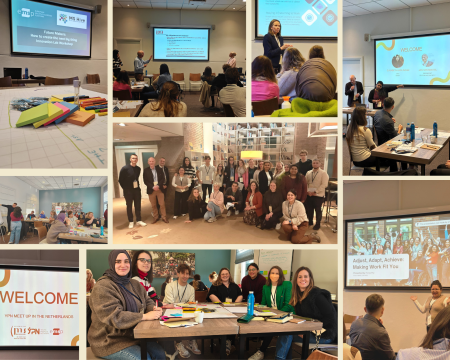
Building Careers, Breaking Barriers: The YPN 2025 Meet-Up in the Netherlands
10.12.2025Animated conversation filled the conference room in Soesterberg, Netherlands, where twenty young people from across Europe gathered for the YPN 2025 Meet-Up. Surrounded by lush forest, these participants—all aged between 18-35 and living with MS, NMOSD, or MOGAD—came together to address a question many face: How do you build a career while managing a chronic neurological condition, advocate for workplace accommodations, and create change in your community?
Organised by EMSP in partnership with the Dutch MS Society, the two-day event gave participants space to develop practical skills for workplace advocacy, co-create peer support initiatives, and build connections with others navigating similar challenges.
Day 1: Working with Strength
Elisabeth Kasilingam, CEO of EMSP and Jan van Amstel, EMSP Treasurer and President of the Dutch MS Society, opened Saturday’s programme. Many participants were meeting for the first time, some recently diagnosed and others living with their conditions for several years. The day’s theme was Working with Strength: Employment and Mental Wellbeing. Rather than focusing on resume writing or interview techniques, the sessions addressed questions participants regularly encounter: Should I disclose my diagnosis? What if it changes how people see me? How do I advocate for myself without apologising for existing?
Reframing the Conversation
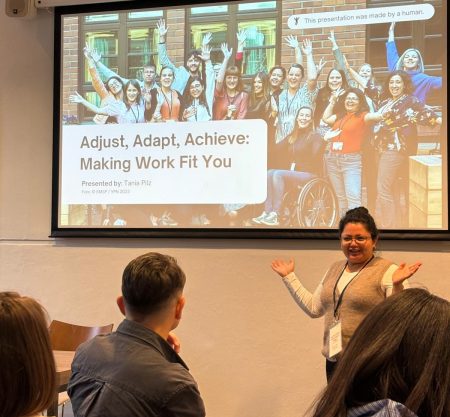
Tania Pilz, Young People Representative on the EMSP Executive Committee, facilitated sessions on understanding disability in professional contexts. In small groups, participants shared their experiences, some recently diagnosed and processing what their condition meant for their careers, others facing new workplace challenges as they took on more responsibility. During a roleplay exercise, participants practiced explaining their condition to an imaginary HR manager in 2-3 minutes. The exercise revealed how language shapes these conversations. By the end of the session, participants had refined their approaches—moving from clinical descriptions of their diagnoses to clearer articulation of their workplace needs, professional strengths, and boundaries. The module provided frameworks for deciding when and how to disclose, rather than prescribing a single approach.
Rethinking Accommodations
Tania presented two versions of her CV. The first showed what employers typically see—credentials, work experience, skills. The second listed what remains invisible in most workplace interactions: burnout, imposter syndrome, MS diagnosis, trauma, anxiety. The contrast illustrated how much of what affects workplace performance goes unrecognised in standard professional assessments.
She reframed the typical accommodation request: “What do I need in order to do my best work and be the best employee I can be?”
This shifts the conversation from deficit-based (“What can’t you do?”) to performance-based (“What enables you to excel?”). Flexible hours become evidence of self-awareness about productivity patterns. Assistive technology becomes a tool for efficiency. Remote work options demonstrate results-focused approaches rather than limitations. As Tania summarised –“True inclusion at work isn’t about making yourself smaller to belong; it’s about expanding workplaces so everyone can thrive.”
Evidence-Based Strategies
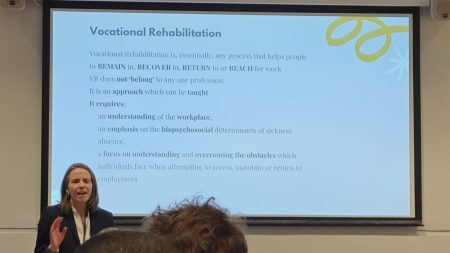
Emma Rogan, brain-health campaigner and Disability Management Expert, presented research on staying professionally active with MS. As a Research Assistant at the University of Galway working on cognitive occupation-based programmes, Emma shared data showing that early return-to-work with modified job activities correlates with faster recovery and better long-term employment outcomes. Her presentation emphasised the bio-psycho-social model—that mental health, physical health, community engagement, and cultural pursuits all influence professional capacity. The session gave participants tools to identify early warning signs that workplace needs aren’t being met, before reaching burnout or crisis points.
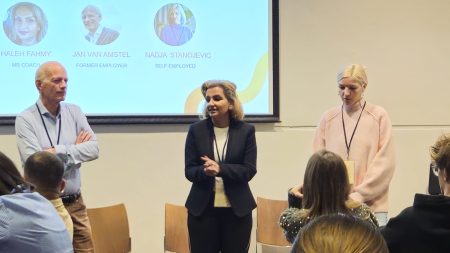
A panel discussion moderated by EMSP Community Coordinator, Anna Revilla, featured Nadja Stanojevic (self-employed, YPN member), Haleh Fahmy (MS Coach), and Jan van Amstel (former hospital director with 25+ years managing approximately 1,000 employees per facility, and father of a daughter with MS). The diverse perspectives showed how accommodation conversations differ across employment contexts—from entrepreneurship to corporate environments.
As the formal session ended, participants gathered for drinks and an icebreaker activity that turned networking into genuine connection as participants identify commonalities across different European contexts—language skills, first-time attendance at EU events and shared professional interests.
Day 2: The MS Hive Initiatives
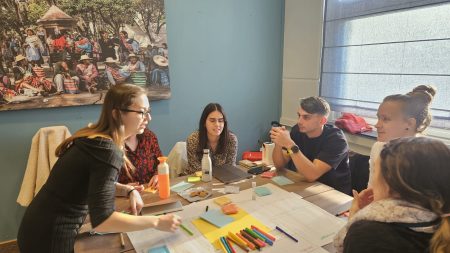
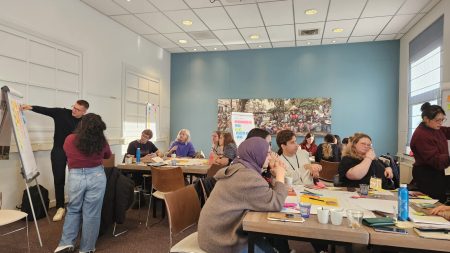
Sunday’s programme shifted to action planning. The MS Hive session was structured around a central principle: small, concrete actions can lead to broader change. Based on pre-event surveys about participants’ interests, four thematic clusters were formed:
Awareness – Educating the public about MS, NMOSD, and MOGAD
Peer Support – Creating safe spaces and preventing isolation
Sports & Movement – Making physical activity empowering and accessible for people with neurological conditions
Developing Concrete Initiatives
Each cluster used a structured framework to develop their proposals:
- Goal: Define the target audience and desired outcome
- Actions: Identify specific, feasible first steps
- Resources: Assess what’s needed (time, funding, partnerships, expertise)
Each group presented their three-minute pitch to the full group. After each presentation, participants provided one specific strength they observed and one constructive suggestion for implementation. This structured feedback helped refine proposals and identified potential collaborations. Several cross-border partnerships emerged from these discussions. Participants exchanged contact details, scheduled follow-up calls, and identified where their initiatives could complement each other.
Building Youth Leadership
The YPN Netherlands Meet-Up demonstrated a shift in how youth engagement functions within the MS movement. Rather than consulting young people about programmes designed for them, the event created space for participants to identify priorities, develop solutions, and build implementation plans.
The initiatives developed during the weekend address gaps participants identified in their own communities—peer support networks in regions where they don’t currently exist, awareness campaigns that move beyond typical MS narratives, and advocacy strategies that center youth perspectives in policy conversations.
The YPN Netherlands Meet-Up was organised by EMSP’s Young People’s Network in partnership with the Dutch MS Society. For more information about YPN initiatives and upcoming events, visit www.emsp.org
Follow the conversation on social media: LinkedIn, Twitter, Instagram, Facebook