Your Account
Building a Stronger Community – An interview with Anita Szántai, President of the Hungarian Foundation for People with Multiple Sclerosis
06.05.2026The Hungarian MS Society – MSMBA became a member of the EMSP in April 2026. In this interview, with their President, Anita Szántai, we discuss the history and development of their organisation. She shares insights into the current Multiple Sclerosis (MS) care landscape in Hungary, the daily challenges faced by people living with multiple sclerosis, and the goals and expectations surrounding their recent membership in the European Multiple Sclerosis Platform (EMSP).
What inspired the founding of MSMBA, and how has the organisation evolved since its early years?
MSMBA was founded in 1999 with a clear purpose: to help ensure that people living with MS in Hungary had access to modern MS treatments and reliable support beyond the walls of hospitals. From the beginning, we believed that patients’ knowledge, health awareness and lifestyle can fundamentally influence their prospects and quality of life. That is why access to trustworthy information, supportive doctor–patient relationships and peer connections have always been central to our work.
Living with MS is not a sprint, but a marathon. People affected by MS and their families need long-term support, understanding and community. Over the years, MSMBA has become a recognised professional partner for neurologists, medical societies, other patient organisations and partners from the corporate sector. Today, we organise nationwide programmes, provide patient education materials, offer rehabilitation opportunities and share reliable information with the MS community. Depending on our financial capacity, the foundation also provides financial assistance to people living with MS who are in need.
Living with MS is not a sprint, but a marathon.
What does the MS landscape look like in Hungary today, and what are the most pressing challenges people living with MS currently face?
In Hungary, MS care is mainly provided through specialised MS centres operating within neurology departments. State-funded modern diagnostic and therapeutic options are available. Neurologists treating people with MS are represented by the Hungarian Neuroimmunology Society, a respected professional organisation whose aim is to support uniform, evidence-based care across the country, incorporating the latest scientific knowledge into everyday clinical practice.
At the same time, the daily lives of people with MS are still affected by many difficulties. Access to complex, individually tailored rehabilitation remains limited, and regional inequalities continue to be significant. In many cases, continuous psychological and social support is also lacking. A major challenge is the recognition and acceptance of invisible symptoms, such as fatigue or cognitive problems. Labour market participation and social inclusion are also important issues. Many people living with MS face financial difficulties, including low disability benefits and limited support for family caregivers.
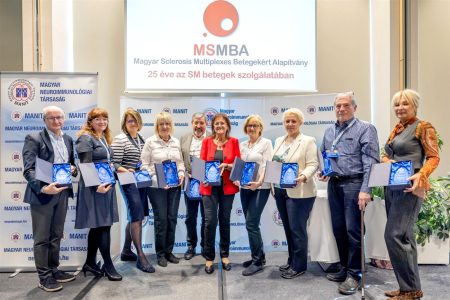
Marking its 25th anniversary, the MSMBA honoured neurologists who had been actively contributiiong towards improving access and health outcomes for people with MS at the 2024 Annual Congress of the Hungarian Neuroimmunology Society.
What are MSMBA’s flagship initiatives, and where will you be focusing your efforts in 2026?
We are proud that MSMBA operates a day care and rehabilitation support centre in North-East Hungary, where people living with MS can spend several days resting, taking part in rehabilitation activities and receiving support, free of charge. We also run the MS Infoline, which provides consultation and guidance, and our MS Movement Programme offers free online physiotherapy and yoga sessions that anyone can join.
Our key activities also include patient education campaigns and community events. One of the most important of these is World MS Day, which helps raise public awareness and brings the MS community together. The lectures and presentations delivered at the event are later made available to people living with MS in Hungary in both video and written formats.
Another pioneering initiative in Hungary is the Caregivers Programme (Támaszadók Program), which draws attention to the role and needs of family caregivers. Twenty Hungarian patient organisations have already joined this initiative.
In 2026, our focus will further shift towards rehabilitation, quality of life, and the development of both digital and in-person educational tools. We also aim to increase our nationwide reach and build new partnerships.
What prompted MSMBA to join EMSP now, and how do you see this partnership evolving in the years ahead?
Joining EMSP is a conscious step for us. MSMBA has reached a professional and organisational level that enables us to take a more active role internationally. Through EMSP membership, we can gain access to European knowledge, good practices and networks, while also creating an opportunity for the perspectives of Hungarian people living with MS to be represented at the European level.
In the longer term, we see this partnership as a two-way exchange of knowledge and experience. We hope it will lead to joint projects, stronger cooperation and greater visibility for Hungarian initiatives within the European MS community.
What impact do you hope MSMBA will have — both for the Hungarian MS community and as a new voice within the wider European MS movement?
Our goal is to help build a strong, well-informed and cohesive MS community in Hungary, where people living with MS and their families are not left alone with their challenges. We also aim to represent patients’ interests credibly towards decision-makers and contribute to the development of a more responsive healthcare and support system.
At the European level, MSMBA can bring a valuable new voice to the wider conversation. By sharing Hungarian experiences, challenges and good practices, we hope to strengthen cooperation across Europe for the benefit of all people living with MS.
Learn more about the MSMBA