Your Account
MCB: Driving Impact: Uniting for MS Policy Change across the EU and National level
17.12.2025The Workshop on Driving Impact: Uniting for MS Policy Change across the EU and National level, part of EMSP’s Membership Capacity Building (MCB) Programme, was held in 2024. In this article, you can explore the main outcomes of the workshop and access the presentation slides for further learning.
Objectives of the Workshop
- Highlight collaborative efforts needed at EU and national levels to address challenges faced by people living with MS.
- Understand dynamics between EU institutions and Member States for effective policy development.
- Empower members with knowledge about EU institutions to advocate for change at both levels, aiming to elevate MS care and brain health onto agendas of upcoming parliamentary mandates.
- Utilise EMSP’s One Million Minds campaign materials to raise awareness of MS care and brain health issues ahead of June elections.
Policy Development: Bridging EU & national realities
What are the competences of the EU
The European Union’s powers are divided into different types of competencies, which determine how decisions are made and which level of government, EU or Member States, is responsible. These include:
- Shared competencies, where both the EU and the Member States can legislate: social policy, economic, social, and territorial cohesion, research, technological development, and common safety concerns in public health
- Exclusive competencies, where only the EU can legislate and adopt binding acts: customs union, competition, and single currency.
- Supporting competencies, where the EU can only support or coordinate actions of the Member States in different areas: protection and improvement of human health, culture, education, vocational training, youth and sport, and civil protection.
The ordinary legislative process works as follow:
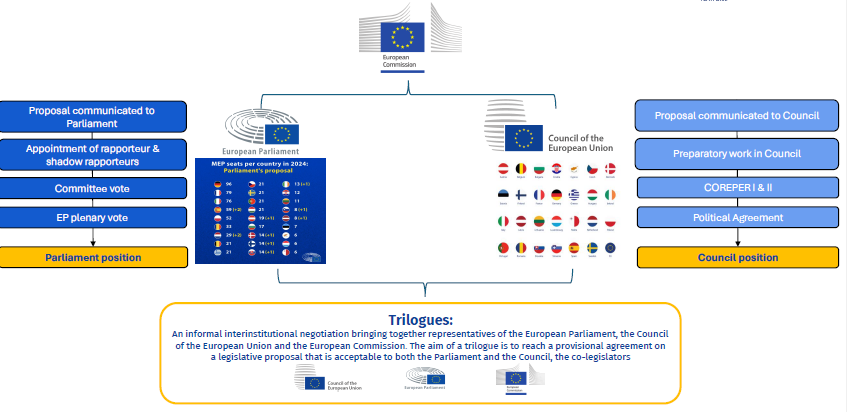
How do the EU and national spheres interact when it comes to policy development?
Understanding the Council
- The Council represents the national governments of Member States and is a key player in the legislative process.
- Different configurations of the Council handle specific policy areas.
- The Council, along with the European Parliament, must approve proposed legislation for it to become law.
COREPER (Committee of permanent Representatives).
- Before discussions at the ministerial level in the Council, Member States are represented by their permanent representatives (ambassadors) in Coreper.
- Coreper prepares the work of the Council by discussing legislative proposals and working towards consensus among Member States.
National governments
- National governments play a crucial role in shaping the position of their respective countries during Council discussions.
- The position of a Member State is typically articulated by its minister responsible for the relevant policy area.
Presidencies
- Each presidency is responsible for chairing meetings at all levels of the Council, representing the Council in relations with other EU institutions, and helping to ensure the continuity of the EU’s work and agenda.
How do the EU and national spheres interact when it comes to policy development?
The European Parliament represents the citizens of the European Union and is directly elected by them.
Members of the European Parliament (MEPs) review, amend, and vote on legislative proposals presented by the European Commission. The Parliament’s position must be taken into account during negotiations with the Council of the EU, ensuring that citizens’ voices are reflected in EU legislation.
To effectively influence EU decision-making, it is important to understand the key levers to pull, tools and opportunities that can shape policies and legislative priorities:
Policy Platforms and Manifestos:
➢ Political parties often present their policy platforms and manifestos during election campaigns, outlining their stance on various issues.
➢ The positions articulated in these documents can influence the legislative agenda and negotiation strategies once the new Parliament is in place.
How can EMSP members contribute to the debate?
The importance of Member States in the Council and the European Parliament was emphasized, particularly in the context of European elections and the crucial role of voting and sharing the manifesto with MEP candidates.
Strategies for EMSP members to actively contribute to the debate were outlined, including:
-
Understanding Member States’ power: Share the manifesto with your national politicians. Member States should take the lead and set examples by addressing the existing gaps at the national level.
-
Leveraging shared experiences: Engage with national politicians and MEPs in your native language for effective communication and understanding.
-
Building alliances: Contact local patient advocacy groups on MS to create synergies and join forces.
-
Digital advocacy: Make use of online platforms, social media and fora to amplify the reach of the campaign.
-
Networking events: Participate in local events, they could offer valuable opportunities for networking and a platform for amplifying the reach of the manifesto.
Practical Session: EMSP Members as Advocacy Architects
- A practical session was conducted, focusing on empowering EMSP members as advocacy architects.
- The case study example of the “Right to be Forgotten for Cancer Survivors” was presented, highlighting the lack of legislation protecting cancer survivors from financial discrimination and proposing solutions to address these challenges.
- Activities and approaches for implementing the “Right to be Forgotten for Cancer Survivors” were outlined, emphasising stakeholder empowerment and policymaker engagement.
Wrap-Up and Way Forward:
In conclusion:
- It is important to focus our efforts to address unmet needs in the MS and neurological conditions community.
- Success stories showcased the importance of innovation in achieving impactful change.
- Participants were encouraged to utilize the resources provided by the OMM campaign to further their advocacy efforts.
- Members were called to dedicate the next months before the European elections to garner support from their MEPs for the manifesto, aiming to transform care for individuals with MS and neurological conditions across Europe.