 Your Account
Strategy for the rights of persons with disabilities
31.03.2026Objectives of the Workshop:
In this workshop, Alejandro Moledo, Deputy Director and Head of Policy at the European Disability Forum (EDF), introduced the Strategy for the Rights of Persons with Disabilities and the work of EDF to support its further development and implementation. There was an special focus on the following topics of interest to our community:
- Disability Employment and Skills Guarantee
- European Agency for Accessibility (provide policy makers with specialised information on accessibility, policy recommendations…)
- Legislation on the affordability of assistive technology
- EU Strategy on the transition from institutions to inclusion in the community.
Icebreaker
The session began with an interactive icebreaker, inviting participants to reflect on the following question:
“What is the most shocking example of disrespect towards disability rights that you have observed in your country?”
Participants shared a range of experiences, highlighting common systemic and societal challenges faced by persons with disabilities across different national contexts.
Key issues raised included:
- Barriers in obtaining disability status
- Denial of boarding on flights for persons with disabilities.
- Excessive delays in the disability assessment process.
- Misunderstanding of illness
- Barriers to travel and mobility
- Slow institutional responses
- Restrictions on assistance dogs
- Poor accessibility in public transport systems
- Inadequate access to institutions
Highlighting the gaps
The workshop highlighted the broader social impact of MS beyond healthcare. Key facts from the MS Barometer 2020, developed with survey responses from 36 national MS Societies representing 35 countries in Europe, were presented:
- 24 countries have no chronic or neurological disease management policy; this includes eight of the 27 European Union Member States
- 20 countries do not include people with MS or patient groups in government consultation groups for MS policies Fewer than half of national MS societies are involved in decisions on reimbursing new MS therapies.
- Among the 15 countries that reported data, only 48% of people with MS are in fulltime or part-time employment
- 21 countries provide no support for young people with MS to complete their education
- In at least 7 countries, people with MS are not legally protected from unfair dismissal from work
- Financial support for early retirement due to disability (28 countries)
- Incentives to recruit or retain people with disabilities in employment (27 countries)
- Legal protections against dismissal from employment due to a health condition (27 countries)
- Flexible working practice legislation for people with disabilities (22 countries)
These findings underline the importance of integrated policies covering healthcare, employment, social protection, and education.
Participants discussed how inadequate social support and fragmented policies can negatively affect:
- Employment opportunities
- Financial independence
- Quality of life for people with MS
- Support for carers and families
EU Disability Policy Landscape: European Disability Strategy 2021–2030
Alejandro Moledo presented the main developments in the European Disability Strategy 2021–2030, adopted by the European Commission.
The strategy aims to improve the rights and inclusion of persons with disabilities across Europe. However, the first phase of the strategy included concrete actions only until 2024, requiring new commitments for the remaining period until 2030.
The European Commission is expected to present a new set of actions in May 2026, which will define the second phase of the strategy. The disability movement, coordinated by the European Disability Forum (EDF), has actively advocated for ambitious new measures to strengthen the implementation of disability rights across the European Union.
In preparation for this second phase, EDF developed its own position already in 2024, proposing a set of policy actions for the period after the initial phase of the strategy. These proposals were based on the manifesto adopted at the European Parliament of Persons with Disabilities, an event bringing together around 700 persons with disabilities and disability advocates from across Europe in the hemicycle of the European Parliament.
Finally, in the presentation Alejandro highlighted the broader political context shaping EU policy priorities. Current discussions within the European Commission increasingly focus on defence, economic competitiveness, and regulatory simplification. These developments may affect disability policies, particularly in areas such as the next EU budget after 2027.
While issues such as housing are gaining political attention, accessibility considerations are not always adequately integrated. In response to these evolving priorities, EDF recently updated its position on the second phase of the Disability Strategy to ensure that disability rights remain central to the EU policy agenda.
Flagship proposals:
A) Disability Employment and Skills Guarantee
In the first half of the strategy, the European Commission adopted the Disability Employment Package, which is a set of deliverables consisting of soft policies such as recommendations, guidance, and a collection of good practices. Some of these are very interesting, according to the EDF, such as:
- Guidance for public employment services
- Catalogue of positive actions to encourage the hiring of persons with disabilities and combating stereotypes
- Guidance on reasonable accommodation
- Study on alternative employment model
With all these recommendations in mind, EDF proposed the creation of a European Disability Employment and Skills Guarantee, inspired by the Youth Guarantee. Key objectives include:
- Improving access to employment for persons with disabilities
- Funding reasonable workplace accommodations
- Supporting training and education opportunities
- Ensuring compatibility between disability benefits and employment income.
Funding would primarily come from the European Social Fund. It’s a proposal being supported by EDF members and the European Parliament..
B) European Agency for Accessibility
Currently, there are different interpretations of what accessibility means. In the EU, we now have laws that are slowly but surely having an impact on the internal market and the European Economic Area.
- European Accessibility Act
- Web Accessibility Directive for public sector
- Accessibility obligations in sectorial legislation: public procurement, rail accessibility, audiovisual services, electronic communications, artificial intelligence…
EDF proposed establishing a European Agency for Accessibility to support implementation of accessibility legislation across the EU. The agency would:
- Support the implementation of the European Accessibility Act
- Provide guidance to the European Commissions, governments and businesses
- Develop technical accessibility standards
- Coordinate expertise across countries.
The proposal is inspired from the U.S. Access Board, a federal agency responsible for accessibility standards in the United States. EDF hopes that this issue will be addressed in the next stage of the strategy.
C) Legislation on Assistive Technologies
EDF highlighted the need for EU legislation to ensure the availability and affordability of assistive technologies.
Currently, access to assistive technologies varies significantly across countries due to fragmented national systems.
Proposed actions include:
- Mutual recognition of assistive technologies across EU countries
- Improved procurement and reimbursement systems
- Faster and more user-centred delivery processes.
D) Deinstitutionalisation and Independent Living
EDF also emphasised the need for stronger EU action on deinstitutionalisation, supporting the transition from institutional care to community-based services. Proposed measures include:
- Collecting EU-wide data on people living in institutions
- Requiring national deinstitutionalisation strategies
- Linking EU funding to progress in independent living policies.
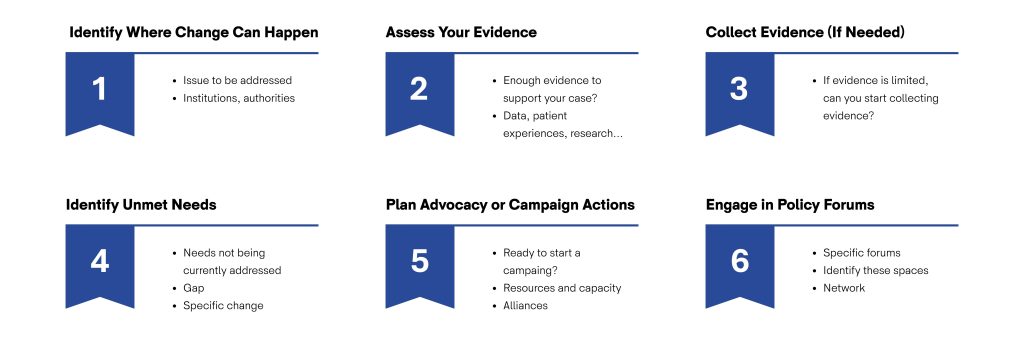
How can MS Societies get involved?
5. Open discussion
The session concluded with an open discussion, during which participants shared reflections and highlighted several key points:
- The importance of strengthening collaboration between national organisations and European-level actors, particularly to ensure a more coordinated approach to disability advocacy
- The existence of significant differences within countries with federal systems, where responsibilities are divided across regional and national levels, often leading to uneven implementation of disability policies
- A strong interest in practical advocacy strategies, including how to effectively engage policymakers, build strategic alliances, and use data and evidence to support policy change
- The need to improve collaboration with non-EU countries, particularly those in the EU Accession process. In this context, the European Disability Forum provides a dedicated toolkit to support organisations in these countries
- Ongoing challenges related to insurance, which continue to create barriers for persons with disabilities in accessing financial services and coverage
Overall, the discussion reinforced the need for stronger coordination, knowledge-sharing, and practical tools to support organisations in advancing disability rights across diverse national contexts

